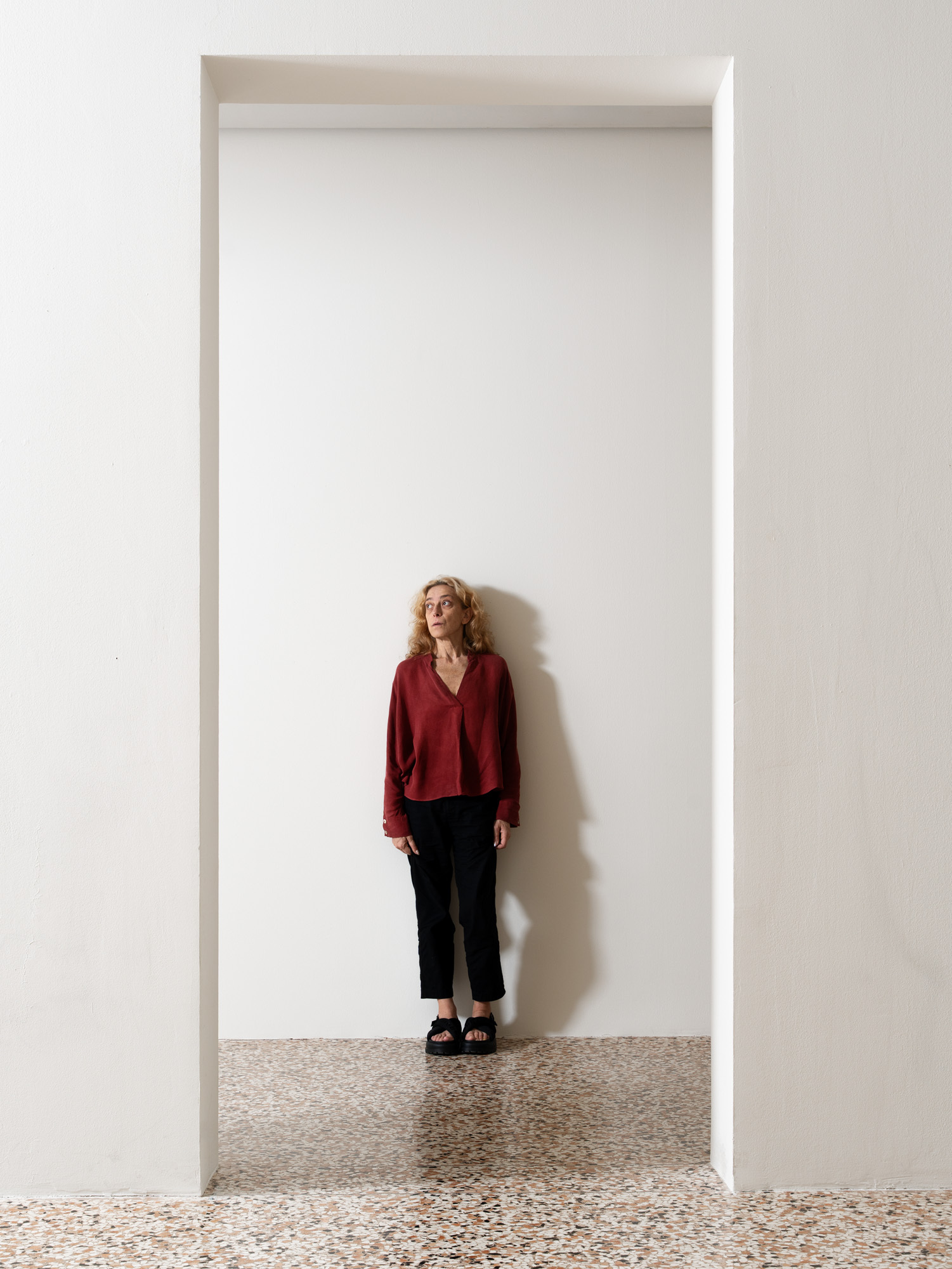
Public Program by Cristina Kristal Rizzo
12/06/2026, 06.00 PM
Secondo grazia
12/06/2026, 06.00 PM
Talk
The first event in Cristina Kristal Rizzo’s public program unfolds in two parts. In the first, Lucia Amara strings together a series of fragments and images related to the theme of grace, ranging from Proust’s In Search of Lost Time to Fabre’s observations on the sleep of hymenoptera and ephemeral forms of inhabitation. Along the way, she draws on the notes in Simone Weil’s Notebooks and Jankélévitch’s notion of the inachevé (the unfinished), arriving finally at the implications of the concept of grace within Greek democratic thought as a distinctive form of the political.
In the second part, Giorgiomaria Cornelio begins with a comparison between the singer Rosalia, Cristina Kristal Rizzo, and Simone Weil: what connects these three figures to the concept of grace? Firmly rooted in their own placelessness, all three have liberated gesture through a radical and joyful practice of obedience. It is from this point—from an obedience that frees and becomes a form of listening—that one may explore a different perspective on the contemporary, one capable of becoming a form of pop art.
BIO
LUCIA AMARA
After completing a two-year program in Archaeology at the University of Catania, Lucia Amara graduated in Classical Studies in Florence with a thesis on the critique of democracy. During this stage of her education, she attended the Balletto di Toscana school and the École Internationale Rosella Hightower in Cannes. She later studied in Bologna (DAMS – Disciplines of Arts, Music and Performing Arts) and Paris (Paris VII, Department of Semiology, and EHESS), focusing her research on vocality, performance, and certain irregular forms of literary language through the work of Antonin Artaud, Fernand Deligny, Michel de Certeau, Louis Wolfson, and Jean Starobinski. She conducted research on vocal archives at the Scuola Normale Superiore in Pisa and worked on an unpublished manuscript by Émile Benveniste on blasphemy within a research project at Sapienza University of Rome devoted to mysticism and language.
Alongside her theoretical and essayistic work, as well as her experience as a critic and educator (with Xing in Bologna and the Scuola Cònia directed by Claudia Castellucci in Cesena), Lucia Amara has developed a dramaturgical practice in dialogue with theatre and dance artists, including Kinkaleri, Cristina Rizzo, Chiara Guidi, Romeo Castellucci, and Gloria Dorliguzzo. She has published Teatro Infantile. L’arte scenica davanti agli occhi di un bambino (with Chiara Guidi, Sossella Editore, 2019) and Utopie Vocali (Mimesis, 2015). She edited the Italian edition of Artaud’s Cahiers: Questo corpo è un uomo. Quaderni 1945–1948 (Neri Pozza, 2025) and, for Cronopio, Lettura d’Eprahi. Il libro perduto di Antonin Artaud.
GIORGIOMARIA CORNELIO
Giorgiomaria Cornelio was born in Macerata in 1997. He is a poet, director, performer, and editor of Nazione Indiana.
His works have been presented at festivals and institutions including the Venice Biennale, the International Exhibition of New Cinema, Rencontres Internationales Paris/Berlin, and Santarcangelo Festival. He has published La consegna delle braci (The Delivery of the Embers, Luca Sossella Editore, winner of the Fondazione Primoli Prize), La specie storta (The Crooked Species, Tlon Edizioni, winner of the Montano Prize and the Gozzano Prize), the essay Fossili di rivolta. Immaginazione e rinascita (Fossils of Revolt: Imagination and Rebirth), and L’ufficio delle tenebre (Tlon Edizioni). As part of the collective Grandi Magazzini Criminali, he edited Ogni creatura è un popolo (Nero Editions). Moira Egan’s translations of a selection of his poems won the Raiziss/de Palchi Fellowship from the Academy of American Poets. He collaborates with publications including Il Tascabile Treccani, The Italian Review, and L’Indiscreto. He curates the project Edizioni Volatili and serves as artistic director of the festival I fumi della fornace. He is currently pursuing a PhD in Fashion at IUAV University of Venice.